
light-header


With over 800 illustrations, this book is an invaluable reference for all collectors, dealers and enthusiasts as the author discusses techniques used for these decorative jugs. Jug collectors, and there are many of them, have general books to refer to, but the few specialist volumes available are either of poor quality or cover only specific wares. This extensively illustrated volume covers all decent-sized everyday serving jugs, which were predominantly made in earthenware or stoneware, and features all decorative techniques, including two good chapters on transfer printing. This book was given the Literati Club's 1998 Award for Excellence for the best specialist reference title.
Swan Hill Press (1997), hardback, ISBN 9781853107474, not currently in print
Try on Amazon
Order Abe Books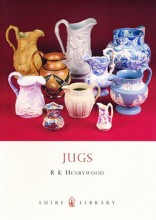
Before the days of modern packaging the only vessel available for fetching, storing or serving liquids was the simple jug. Jugs were the staple product of many pottery firms and, since most households would need several, the potential market was vast and there was great competition among the manufacturers. Decorative jugs sold best and, despite the fact that jugs were utilitarian, a vast number of attractive designs emerged. Although jugs from the eighteenth century are scarce, those from the nineteenth and twentieth centuries have survived in large numbers and can fill many a collection. This book reveals the many and varied techniques of decorating jugs throughout the ages, including one chapter on transfer printing. An ideal introduction to the history and design of jugs.
Shire Publications (2009), paperback, ISBN: 9780747807346, £5.99 / $12.95
www.shirebooks.co.uk or www.amazon.com
Order Here

This is the most comprehensive list of Staffordshire potters ever published and includes much information unavailable in existing literature. This area produced some ninety percent of the pots made in England and is of prime importance in the study of British ceramics. The list has been assembled by extracting the data contained in directories published in the period, covering more than 10,000 entries from some sixty-one volumes. The book itself consists of introductory chapters covering historical aspects of the survey, a fascinating evaluation of the area under review and the directory of authors and publishers, followed by two major chapters - the assembled alphabetical list of over 3,000 potters and listings of all the original directory entries in date order. The work covers all potters, regardless of their products, working between 1781, the date of the earliest surviving directory, and the beginning of the twentieth century, by far the most popular period for collectors. Another standard reference work for anyone interested in British pottery and porcelain.
ISBN: 9781851493708 Antique Collectors' Club (2002), hardback, ISBN 9781851493708, £45.00 / $89.50
Order on Amazon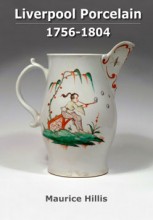
Liverpool Porcelain 1756-1804 has 15 information-packed chapters covering all the 18th century Liverpool porcelain factories. The history of each factory is clearly set out, including who operated them and their periods of production. The wares of each factory are described and compre-hensively illustrated in a vast array of color photographs. Many of the pieces have never been illustrated before. The ways in which the porcelain of each factory can be identified are explained. The book includes 570 pages and 1,300 illustrations and is printed with hardback covers.
An important chapter illustrates and discusses over 120 underglaze blue printed patterns and another is devoted to overglaze printing on Liverpool porcelain by John Sadler and others. Dated pieces are discussed, as is the marketing of Liverpool porcelain and its export to America. There is a foreword by Geoffrey Godden.
Maurice Hillis is an independent researcher on ceramic history. His ceramic interests are extremely varied and he has published widely on 18th and 19th century pottery and porcelain. He has also lectured extensively on ceramics, in both Britain and North America. In 2001 he was elected Chairman of The Northern Ceramic Society, the largest society in Britain devoted to the study of pottery and porcelain and its history.
For a number of years, Maurice and his wife Lyn have organized two annual ceramic seminars for the NCS--a Winter Weekend at Manchester University in January and a Summer School at the University of Chester in August. Ceramic enthusiasts from around the world attend these events.
Liverpool porcelain is one of his particular interests. He has been researching this book for over thirty years and is the acknowledged authority on this difficult subject.
---Text modified slightly from the website "The Liverpool Porcelain Book."
Order Here
Advertising pot lids can be found from many countries particularly English-speaking nations and are collected by a dedicated group of enthusiasts across the world. These fascinating transfer-printed ceramic containers often feature inventive designs as well as details of the individuals and companies that sold them. They were used to retail commodities such as tooth paste, cold cream, food pastes, hair preparations, ointments & salves, and a range of other products. The vast majority were originally thrown away after a single use and have been re-discovered over the past 50 years or so from the excavation of former rubbish tips.
It has taken 11 years to compile this book, which is the result of contributions from hundreds of collectors from around the globe. It aims to catalogue, as far as possible, all UK and Irish advertising pot lids that were used broadly between 1830 and 1930, as well as providing a brief overview of examples that were used in other countries.
This guide records over 8,500 different examples, features over 7,500 images and provides trading details on over 600 businesses that used them. It is the authors’ intention to continue cataloguing examples not featured and publish a supplement to this book when feasible.
Printing supported by a TCC Paul and Gladys Richards Charitable Foundation Research Program grant.
Pricing:
Standard - £120 (hard-cover but very limited availability; priority to contributors); £70 soft-cover.
TCC Members - £100 (hard-cover) and £60 (soft-cover)
Contact seller for shipping estimate / cost jimlayden1@gmail.com

The emergence of Herculaneum pottery in early nineteenth-century Liverpool marked a pivotal moment in the clay arts. This book provides a comprehensive history of Herculaneum pottery—highly sought after in North America—and its rapid rise to international prominence.
Order at Amazon
Preface: An authentic, technical Directory of the Staffordshire Potteries has long been felt as a necessity to do justice to its requirements. This, the first edition, is therefore submitted to the trade, and the usefulness of its aim and objects being seen, we feel assured of being able, on a future occasion, to supply such deficiencies as may be found in the present issue...
This is a digital copy of a book that was preserved for generations on library shelves before it was carefully scanned by Google as part of a project to make the world’s books discoverable online.
Order Here
Edited by the Club Chairman, and compiled from Club research over the past 40 years, this new B5 size publication offers a full colour 175 page guide to Ironstone patterns produced by the Mason's factory from c1813 to c1848.
 The price is £35 including postage. Cheques should be made payable to: Mason’s Collectors’ Club. All enquiries about payment, postage, other publications and Club membership to: alandwhite_lenborough@hotmail.com.
(Those unable to purchase with pounds should contact the club secretary to determine best method of payment.)
Alan D White
Secretary
Mason's Collectors' Club
Lenborough House
Hillesden Road
Gawcott
Buckingham
MK18 4JF
UK
www.masonscc.co.uk

Ny: Crown Pub Inc, 1969 Dust jacket good, rubbing to edges. Blue cloth with gilt lettering, good, corners & spine lightly bumped. Includes 129 black & white pictures & 108 marks. light foxing. Cloth. Good/Good. 4to - over 9¾" - 12" tall. Seller Inventory # 5027
Order at Abe books
Terry Lockett, the founder Chairman and a former President of the Northern Ceramic Society, is a freelance lecturer and writer who gave many talks over the past 40 or more years that involved a good deal of research, but were given just once and never recorded. This book is a compilation of material that reveals much about Terry’s life and also the societies and institutions with which he has been associated in the past 50 years.
Ordering Information:
Sole Distributor is Reference Works Ltd. Price: 19.90 GBP plus shipping; Email: sales@referenceworks.co.uk

THIS little book has been compiled to meet the wants (expressed in hundreds of letters) of those who own old china, particularly old English china, and would like to know more about it, and to stimulate others to whom the fascinations of china collecting are as yet unknown.
There are many more to whom we hope to appeal: – those who are Interested In their country's history during that strenuous time when the colony cast aside its mother's hand and took Its first steps alone. It may well stir our patriotism to look on the plain buildings our ancestors were content to view as " Beauties"; to note the primitive methods of transportation both on land and sea; to revise our knowledge of such famous victories as McDonough's, or Bunker Hill, and to study the rugged features of those who worked and died to make our country what she Is. All this and more may be found within the limits of a collection of "Old Blue."
For more information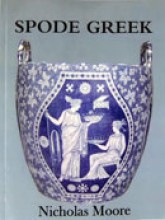
Spode Greek is a one hundred and seventy page soft-back publication by Nicholas Moore. It will serve as an invaluable reference work for Greek pattern collectors, historians and transferware enthusiasts alike. The author has been collecting Spode transfer printed pottery for over thirty years and during that period, developed a major interest in Spode’s Greek patterns. The past eight years has seen Nicholas research every aspect, including historical contexts, of this extremely striking pattern. The book is fully illustrated with over two hundred and fifty full-colour illustrations along with nearly fifty black and white source print images. Not only does the book cover the whole pottery side of the Greek pattern, it also majors on the diverse and rich history behind these patterns which goes back nearly 2500 years. The book is laid out in a very careful way that shows each pattern alongside the relevant source material and/or any corresponding elements from the Spode manufacturing process. There is also a section that depicts some of the diverse shapes that Spode produced which were decorated with the Greek pattern. In addition to illustrations of the pottery, the work also affords the reader the rare opportunity to see the original copper plates from the Spode Museum Trust. This one hundred and seventy page book will inform and thrill in equal quantities and will reaffirm the delight that is collecting blue and white transferware.
Postage cost in the UK - £4.50, Rest of the World - £9.50
Condition: Brand New
Size: 9.75" x 7.5"
Price:£35.00

Publisher: Lucia Marquand
Hardcover $40
Purchase on Amazon
Order at AmazonCollecting objects gives enormous pleasure to approximately one third of the population, providing such benefits as intellectual stimulation, the thrill of the chase, and leaving a legacy. On the other hand, the same pursuit can engender pain; for example, paying too much for an object, unknowingly buying a fake, or dealing with the frustrations of collection dispersal. Until recently, there was no objective way to enhance the positive (pleasure) aspects of collecting and minimize the negative (pain). Now, for the first time, scientific research in neuro- and behavioral economics gives us a way to turn this around.
- Introduces neuro- and behavioral economics for collectors and art professions to help them understand their own decision making
- Brings a unique collector's perspective, providing insight for art dealers, collectors, and museum professionals. Includes artworks and objects that have never been published before
- Chronicles the exhibit Elegance from the East: New Insights into Old Porcelain, which was one of the first museum exhibits to use a neuropsychological approach
- Examines Order of Cincinnati fakes versus authentic articles, with photos to demonstrate
Neuroeconomics is the study of the biological foundation of economic thought, while behavioral economics incorporates insights from psychology and other social sciences into the examination of monetary behavior. By using examples from these disciplines, Shirley M. Mueller, MD, relates her own experiences as a serious collector and as a neuroscientist to examine different behavioral traits which characterize collectors.
The contents of this book are cutting edge, unique and sure to get attention. Mueller breaks new ground in an area not previously explored. Her information is relevant not only for collectors, but also for colleges, and universities which teach collection management, plus museum staff who interact with collectors and dealers of objects desired by collectors. Heavily illustrated with ceramics from Mueller's collection and packed with useful information, this book will become a required vital resource.

Within its ancient boundaries, Staffordshire is a county of diverse and contrasting historic landscapes. The two major contributions of the Black Country and the Potteries that now dominate the county co-exist with smaller towns that in their day had similar standing as centres of the Mercian state. The county's world-renowned industrial complexes based on ceramics and the metalware trades, products of the industrial revolution and before, sit alongside agricultural systems embracing both arable and grassland specialisms. In the built environment, castles rub shoulders with the meanest of urban-industrial housing, and religious expressions range from the cathedral centre of a vast diocese, through the austere surroundings of Mow Cop, the birthplace of primitive Methodism, to the humble and ubiquitous well-dressing ceremonies. The overtly planned landscapes of Needwood Forest and the gardens of Alton Towers mingle with the seemingly natural appearances of the uplands of the Moorlands and the heathlands of Cannock Chase. These many and varied landscapes are both products and reflections of a multiplicity of histories.
Students of the county have been keen to explore and relate these pasts. However, no systematic attempt has been made to express these accounts in spatial form. For the first time, this book seeks to demonstrate by maps the various histories that contribute to the diversity of Staffordshire. With its succinct discussions and detailed map presentations of these themes, incorporating new thinking and recent research, the atlas provides an innovative and major contribution to the study of the history of Staffordshire.
Within its ancient boundaries, Staffordshire is a county of diverse and contrasting historic landscapes. World-renowned industrial complexes sit alongside agricultural systems; castles rub shoulders with urban-industrial housing; the cathedral centre of a vast diocese lies close to the birthplace of primitive Methodism; overtly planned landscapes mingle with the uplands of the Moorlands and the heathlands of Cannock Chase. These varied landscapes are products and reflections of a multiplicity of histories. This book seeks to demonstrate by maps the various histories that contribute to the diversity of Staffordshire. With its succinct discussions and detailed map presentations of these themes, incorporating new thinking and recent research, the atlas provides an innovative and major contribution to the study of the history of Staffordshire.
Contents:

2016 The Paul and Gladys Richards Foundation Research Grant Program
Advertising pot lids can be found from many countries particularly English speaking nations and are collected by a dedicated group of enthusiasts across the world. These fascinating transfer-printed ceramic containers often feature inventive designs and typefaces as well as details of the individuals and companies that sold them. They were used to retail a broad range of commodities and the vast majority were originally thrown away after a single use. In the last 50 years or so, they have been re-discovered from the excavation of former rubbish tips.
These containers became available due to pioneering developments in the pottery industry. The creation of wares than were durable, alongside advances in transfer printing, paved the way for mass production. Staffordshire, England became a key production centre that also supplied a hungry export market. The excavation of several rubbish tips from several former Staffordshire potteries has confirmed that some of Canada’s pot lids were sourced and manufactured in the UK. These pot lids are often the only tangible evidence of long defunct businesses that elected to use the latest form of packaging. Canada, in comparison to many other countries, records relatively few examples although there are a number that are highly appealing and desirable. Over the past decade or so, the prices for coveted examples have achieved astronomical sums as collectors have recognised their rarity and historical significance.
This guide is the first time that all-known Canadian pot lids have been carefully catalogued and the history of the businesses that sold them properly researched. They represent an important part of our social development highlighting sophisticated marketing and manufacturing skills although they are too often underappreciated. This guide, complementing other recent publications, will help change this attitude and bestow the recognition they rightly deserve. It puts Canadian lids firmly on the map.
How to order hardcopy
Price US $10.00 Price UK £10.00 pounds
Postage determined when order is placed Email b.pynn@shaw.ca to place an order
Download PDF (members only)

For all who own British antique blue-printed pottery, this book is essential reading.
With over 1,000 illustrations (including 12 pages in full colour), each giving full details of maker (where known) and year of manufacture, et cetera, it provides readers with the opportunity to identify their favorite pieces.
In addition, it contains essays by thirteen of the leading authorities on these ceramics, which describe how the wares were made and marketed in all parts of the world, details about each of the manufacturers (including illustrations of the marks used on each item), and information about the patterns used and the sources from which they were derived.
Prepared to celebrate the 25th anniversary of the founding of the Friends of Blue (the Collector's Club), the book contains information and photographs of 700 of the most rare, beautiful, and unusual items from the collections of the members, many of which have never been published before. Those who missed the exhibition at the Wedgwood Museum, where these were exhibited, need not despair for they are all catalogued and illustrated here.
Copies may be ordered direct from Friends of Blue at fobchair@outlook.com . Price £5.00 per copy, plus postage.

140 pages, 450+ illustrations.
Dated in Blue is a catalogue of dated underglaze blue painted earthenware, both creamware and pearlware, from 1776 to 1800. One hundred and ninety four examples are featured, the majority of which are illustrated and published for the first time. They give a unique insight into ceramic bodies, shapes and decorative styles used at the time of their production, and much of the information gathered can be used to help date other types of earthenware being produced concurrently.
International Buyers, Price is £22 (sterling) plus postage
To order & for postage fees, email datedinblue@gmail.com

"This book presents research by the author Peter Roden, who is a descendant of Josiah Spode I and who also has a special interest in Spode history. Whilst not Spode specific, it is hugely important for anyone interested in the history of Spode.
I have found Roden's research of invaluable use when putting flesh on the bones of the early Spode businesses. This book brings us detailed new information about these businesses. It gives a more detailed look at property owned by the Spode family and helps to date more accurately the beginnings of the Spode business.
During the period, 1700-1832, the copyhold business in the court of the manor of Newcastle under Lyme provides a unique record of the development of the central area of the Staffordshire Potteries. Over 50 different potworks sites are mentioned in these records; fields can be followed into housing developments; and for many of the thousands of people involved in the developments, there are details of their family history and financial affairs. Who knows, this might be where you find that missing link in your family history researches.
When you learn that there are over 12,000 pages of minutes in these old manor court records then it is not surprising that Roden describes it as his '15 year gestation period' for this book! The amount of diligent and careful research that has gone into this publication is astounding.
Don't be fooled into thinking this book is just a list of potworks and businesses. It is a very enjoyable read and for anyone unfamiliar with these types of records, like me—the first part of the book explains the complexity of interpreting the archaic formalities found in copyhold records. It concludes with several appendices, including a description of how the manor court operated, who ran it, and what other business it was still doing at this time as its wider medieval functions declined. The book is extensively indexed, including the names of almost 2,000 people.
There are maps and diagrams, tables and annotated plans. The illustration on the cover is of Spode's'Meadowe and Potworks potovens pothouses….' of the late 1700s. It's worth buying it just for that if you are a Spode enthusiast! The Meadowname was still in use on the site up to its closure in 2009, by then relating to a modern building. I hope that any commercial development on the site in the near future will keep this name alive. Perhaps we can have a Meadow Café!
I admit to a definite bias towards Spode but every time I pick this book up I learn something new about The Potteries, its industry, associated properties and people. For anyone who thought a complete record existed of all the businesses connected with the famous pottery industry in Stoke-on-Trent at this formative time, think again, for here are new businesses and names previously unknown.
This is must-have book for anyone with a love of Spode history and of the ceramic industry in general. An absolute bargain at £25 [+p&p (£4.50 UK p&p). You can purchase this direct from the publisher."
—Review (slightly modified by the TCC Web Administrator) courtesy of Pam Woolliscroft in her website Spode History.
Orders to: Wood Broughton Publications, 1 Wood Broughton Barn, Cartmel, Grange-over-Sands, LA11 7SJ. Price £25 [+p&p (£4.50 UK p&p)]. Contact publisher for International postage charge.
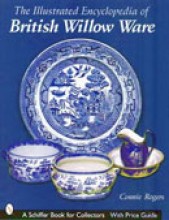
The origin of the Willow Pattern is traced carefully. References to statements by Dr. Geoffrey Godden, Geoffrey Priestman and Robert Copeland add authority to Connie’s account which adds new information on a recently found Chinese export porcelain plate that has a very close resemblance to the Standard Willow Pattern design. The name “willow pattern” has been rather loosely used over the years. Connie distinguishes between the various different designs – Standard Willow, Mandarin, Two Temples I & II, Booth’s Real Old Willow, Canton and several others. There is a Table of Manufacturers which links the type of patterns and colors to each maker.
There is a section listing retailers and importers with special backstamps (marks), and another dealing with wares with unattributed marks. An Index of Potters’ Initials on Marks identifies the company using the initials. The book also includes a Glossary of Terms, Shape Index and a schedule of different pattern names for Willow patterns used by the manufacturers and/or researchers as well as a comprehensive bibliography.
The major part of the book is the catalog of over 400 manufacturers with marks, photos, reprints of ads from “The Pottery Gazette,” brief histories and type of willow made. This will be of great value not only to collectors of the Willow Pattern, but to all collectors, dealers and students of British ceramics. It is a treasure house of information and an indispensable book of reference.
“Of all the books on the Willow Pattern, Connie Rogers’ Illustrated Encyclopedia of British Willow Ware is destined to be the THE definitive work.” -- Robert Copeland, January, 2004
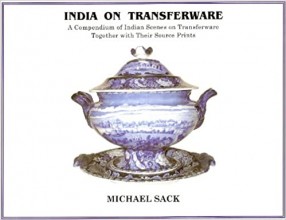
Every known scene of India on transferware is included in one book, together with photos (where available) of both the patterns and the source prints from which they were derived. Each pattern and its source prints (sometimes there are as many as five) are shown side by side so that they can easily be compared.
Order at Amazon
Available as a PDF download. A classic publication, still referenced by researchers. Download here.

This delightful book examines the graphics found on all kinds of children's alphabet ware, along with fascinating histories of the firms that produced it. Primarily made in nineteenth century Britain, America, and Germany, these ceramic plates, metal table and flatware, glass dishes, and mugs are considered a reflection of the technologies, values, and styles of the Victorian era. Alphabetically arranged, the twenty-six lettered chapters each tell part of the story: A begins the tale with a bit of American history, B tells of the early bonfires and nineteenth century bottle ovens, C discusses commercialism, D displays deep dishes, E reviews the role of the ware in educating the young and so on, all the way to Z. The extensively researched text is accompanied by over 1000 stunning photographs of these historic pieces, with detailed captions providing measurements, information on manufacturers and marks, circa dates, and current values. A must for every enthusiast's library, this unique and comprehensive text guides readers through every aspect of collecting alphabet ware. -- description from Amazon.com
Purchase from Amazon
Inexpensive children’s china was made in Britain throughout the 19th century as gifts for good behavior, christening presents, souvenirs, and rewards for excellence in school. It was inexpensive because the pattern was transfer-printed on the pottery rather than hand-painted. Of the many hundreds or perhaps even thousands of patterns made, I have culled patterns that include animals. Animals on children’s pottery both delight and instruct. For example, when you look at the first page you’ll see that “A” is the first letter of the alphabet and is represented by the word “Ape”. Not only is the image amusing, but by extension, the child could be asked “What else begins with the letter “A”? What a lovely way to learn the ABCs!
Judie Siddall has combined her love of children and china to create this book. She taught in the Palo Alto, California Parent Education Program, PreSchool Family, for 25 years, and has operated Merlin Antiques, specializing in 19th century British transfer printed pottery, for 21 years. She is a founding member of the Transferware Collectors Club, and has served as its president, vice president, and membership chair.
PDF of information.
To order for $17.98 + shipping from Lulu.
Contact the author.

The reputation of Henry and Richard Daniel is based on their glorious porcelain but, in spite of its importance to the commercial success of the company, little has been written about their huge production of earthenware. Signposts to Daniel earthenwares were provided in the pioneering works of Geoffrey Godden and Michael Berthoud, but few have followed that path until now. This is the first book to attempt a comprehensive survey of the various shapes and patterns produced in earthenware by H&R Daniel and to differentiate them from other contemporary manufacturers such as Thomas Dimmock & Co, to whom they are frequently attributed.
Brian Smith and Bryan Beardmore have between them over fifty years experience in identifying and collecting Daniel, and are co-authors of the most recent work on Daniel porcelain tablewares. John and Jeannette Simpson had considerable experience as technical authors before being drawn into the ceramics world, and since 2010 have been editors of the Journal of the Daniel Ceramic Circle.
Foreword by Geoffrey A Godden
Published in a limited edition of 200 copies by the Daniel Ceramic Circle with the generous support of the Transferware Collectors Club through the Paul and Gladys Richards Charitable foundation Research Program.
134 pages, paperback, printed in full colour throughout.
ISBN: 978-0-9562391-2-9
Cover price £25 but for TCC members there is a special price of £20.
Shipping extra – within UK £3, overseas buyers please enquire.
To order this book please email dcc@simpson.uk.com or see website www.danielcc.org
Order Here
Members free downloadBack in 2015 the TCC kindly gave us* a grant towards the publication of our book, H&R Daniel Earthenwares. As with any publication on a new subject it focussed attention and resulted in new items being brought to light. This year we felt we had enough material to publish a supplement. We issued it as a supplement to the May DCC Journal, so that members would receive it free of charge. We felt that the TCC should also have a copy with our compliments and thanks. — * John & Jeannette Simpson, Brian Smith, Bryan Beardmore.

Over 440 vivid color images display the wide range of ceramics produced by the English pottery firm, established by Josiah Spode in the 1760s and continuing today. From historic blue and white transfer printed wares of the early 1800s to popular dinnerware patterns of the 1900s, this book includes sprig decorated wares, delicate bone china table and tea sets, graceful figurines, and sturdy stoneware candlesticks and loving cups.
Order at Amazon
This book is an overview of the middle and later periods of the Cambrian Pottery transferware production. It attempts to provide an understanding of the difficulties involved in precisely attributing patterns to the different periods of production especially as some patterns were used over long periods of time. We provide pattern lists for each period. The 48 full colour images are to an extent patterns we have not previously illustrated.
Order Here
A new publication exploring the work of Thomas Rothwel l—
available for FREE download — the book is the result of some 40 years of research by TCC members Arleen and Grahame Tanner. The publication details the importance of Thomas Rothwell in the transfer printing process and charts the history of one of the most famous engravers of the period.
TCC members and site visitors can download the publication free of charge.
For those interested in a printed copy, this 64- page book is available for the price £18.00.
Order on Lulu.com
This book has 220 pages with over 90 patterns and 420 color illustrations including Chinoiserie, Rural, Commemorative, Transitional, Sheet and previously unattributed. The “Table of Contents” titled PATTERNS IN ORDER OF APPEARANCE makes the book easy to use as a reference. Also helpful are the Alphabetical List of patterns and the Alphabetical Index to Patterns with Relevant Marks (with a selection from Book 1).
Ordering Information:
Price: 28 GBP plus shipping.
arleenandgrahametanner@btinternet.com

This is the first book to deal solely with the public and private commemorative pieces from the Swansea Cambrian Pottery. It shows also how these pieces relate to other known Swansea patterns and borders.
Published in 2013, the book has 29 pages and features 99 colour illustrations. It measures 8 1/2 by 11 inches.
A pdf of the book content can be downloaded here free of charge.
The softcover version of the book can be purchased at a price of £15.00. See www.lulu.com for purchase.

The book was published in 2005 and was the first book to deal solely with the transfer printed ware of the Cambrian Pottery, Swansea (known as the Swansea Pottery).
A 225-page volume, the book includes a wealth of information: 90 patterns including Chinoiserie, Rural, Transitional, Sheet, Commemoratives and later patterns, 310 colour illustrations, sections on the potters' working and living conditions, Swansea Pottery employee census records, the first checklist ever produced of 349 known patterns from ALL Welsh Potteries, a well-illustrated marks section, an alphabetical index and an extensive bibliography.
Purchase information £26.00 + £5.00 p&p. For further info, please contact arleenandgrahametanner@btinternet.com
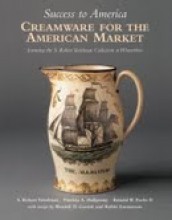
with essays by Wendell D. Garrett and Robin Emmerson.
Life in the early days of the young republic was still very much tied to England and its resources. All those who could afford to do so ordered their creamware sets of dishes and goods from English potters, who were only too happy to produce and decorate the requested images that memorialized Revolutionary War heroes, newly elected presidents, maritime merchants, and patriotic sentiments. One of the largest collection of such creamware items was amassed by the late S. Robert Teitelman. This publication highlights 50 of the pieces in the S. Robert Teitelman Collection at Winterthur as well as an additional 25 pieces and decorative arts objects from Winterthur collection. Enhanced by essays that address life in the young republic, the Liverpool pottery industry, and the Atlantic maritime trade, the volume features some of the finest examples of the period.
hardcover, 304 pages; 750 color illustrations
Rich with content for ceramic collectors, researchers, authors, curators, and historic archaeologists, the sites are sure to deliver value for their visitors. The exhibition’s curators continue to enhance them and, now, with site application upgrades, including a new magnification feature and upgraded content management capabilities, the TCC and its collaborators are pleased to relaunch these exhibits, all free to a worldwide audience.
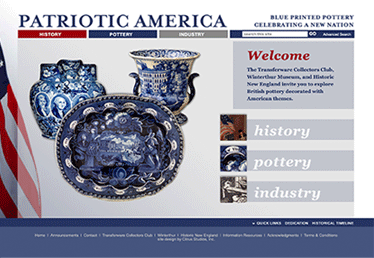
Branded Patriotic America, debuted in 2014 in collaboration with Historic New England, and the Winterthur Museum

Launched in 2015 in partnership with the Northern Ceramic Society.
 Not a member but want to receive email updates?
